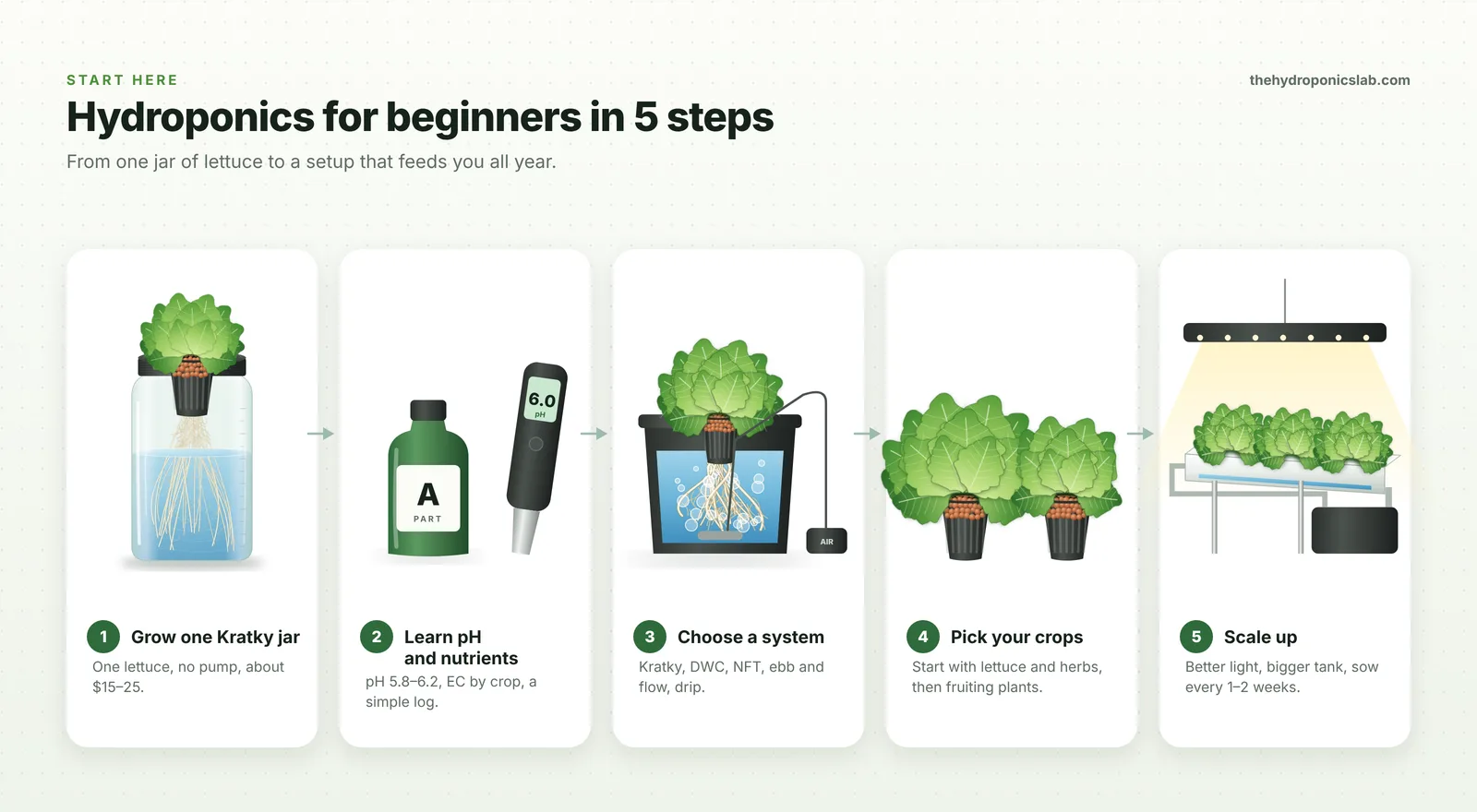
Welcome to The Hydroponics Lab. If you want to grow fresh food at home without soil, but you are not sure where to begin, you are in the right place. This page is a simple path in five steps, from one jar of lettuce on your kitchen counter to a system that feeds you all year.
You do not need a greenhouse, a big budget or a science degree. You need a container, some nutrients, a light source and about 15 minutes to set up your first plant.
What hydroponics is (in 100 words)
Hydroponics means growing plants without soil. Instead of searching through earth for food, the roots sit in water that already contains every mineral the plant needs. You control the nutrients, the pH and the light, so plants usually grow faster, use far less water than in a garden, and can grow indoors in any season. The word comes from the Greek for "water" and "work". People have grown plants this way for centuries, NASA has tested it for growing food in space, and today it produces much of the lettuce in supermarkets. At home, it can start with a single jar.
Step 1: Grow one Kratky jar
The best way to learn hydroponics is to grow one plant, start to finish, with the simplest method there is: the Kratky method. It needs no pump, no electricity and no daily work.
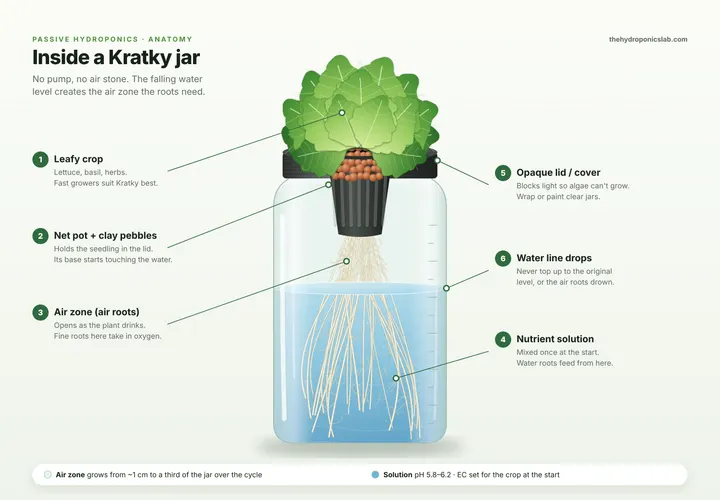
You fill a jar with nutrient solution, place a lettuce seedling in a net pot in the lid, and leave it. As the plant drinks, the water level drops and the roots get air from the gap. In about five or six weeks, you harvest.
What you need: a wide-mouth mason jar, a 2 or 3 inch net pot, a rockwool cube, lettuce seeds, a hydroponic nutrient and a pH kit. Total cost: about $15 to $25, and most of it lasts for many crops.
Why start here? Because this one jar teaches you the three things every hydroponic system depends on: nutrient strength, pH and roots. And you will have a lettuce to show for it.
Read next: The Kratky method: complete guide and mason jar hydroponics.
Step 2: Learn pH and nutrients
In hydroponics, the water is the plant's only food. Two numbers tell you if that food is right:
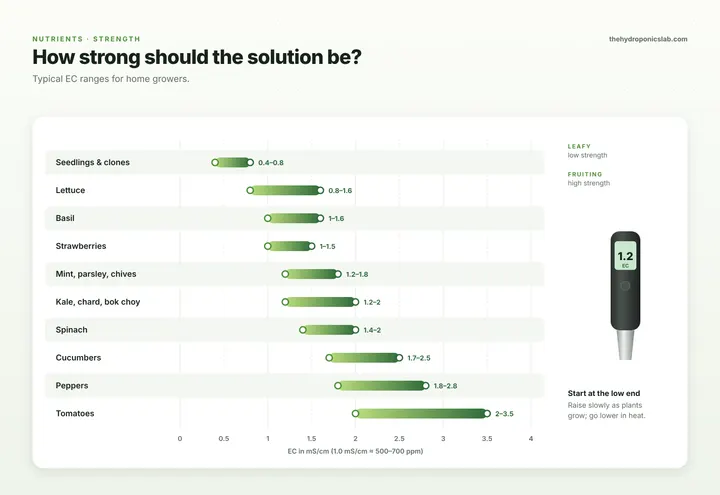
- EC (or ppm) measures how strong the nutrient solution is. Lettuce likes it light, around 0.8 to 1.6 mS/cm; tomatoes like it much stronger.
- pH decides whether the plant can absorb what is in the water. Most crops do best at 5.8 to 6.2.
You do not need to master the chemistry. You need a pH test kit or pen, a bottle of pH Down, a hydroponic nutrient (not a soil fertilizer) and a habit: mix nutrients first, then adjust the pH, then write both numbers down.
Buy an EC meter when you move beyond a few jars. It is the tool that saves the most plants.
Read next: Hydroponic nutrients explained, the ideal pH for hydroponics, EC vs PPM.
Step 3: Choose a system
After your first harvest, you will want more plants. Each hydroponic system solves the same problem (giving roots water, nutrients and oxygen) in a different way.
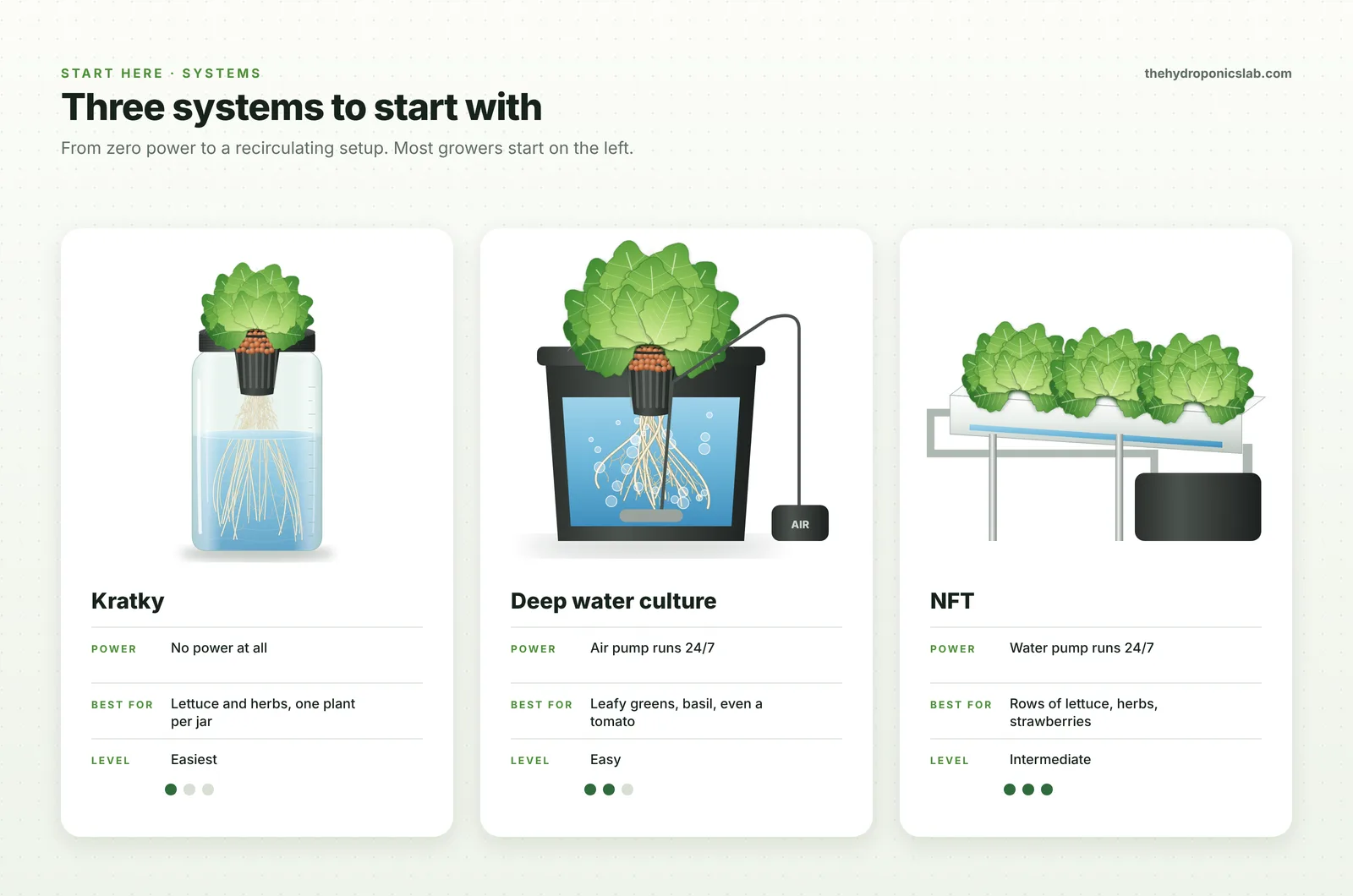
| System | How it works | Effort | Best for |
|---|---|---|---|
| Kratky | Plant sits over still solution; air gap forms as water drops | Lowest | First crops, leafy greens, herbs |
| Deep water culture (DWC) | Roots in solution, air pump bubbles oxygen | Low | Lettuce, herbs, basil, even tomatoes in buckets |
| Wick system | A wick draws solution up into the medium | Low | Small herbs, houseplants |
| Ebb and flow | Tray floods and drains on a timer | Moderate | Mixed crops in pots |
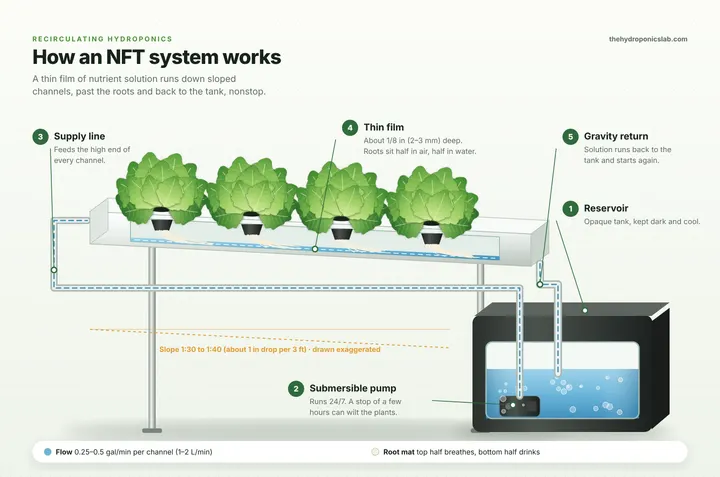
| NFT | Thin film of solution flows down sloped channels | Moderate | Many lettuces, strawberries, vertical setups |
| Drip | Emitters drip solution onto a medium | Moderate | Tomatoes, peppers, cucumbers |
| Aeroponics | Roots hang in air and are misted | Higher | Advanced growers, fast growth |
Our advice for most beginners: after Kratky, build a DWC bucket or tote. It is cheap, forgiving and grows almost anything leafy. Move to NFT or drip when you know what you want to grow at scale.
Read next: Types of hydroponic systems and DWC vs NFT.
Step 4: Pick your crops
Start with plants that grow fast and forgive mistakes, then work up to the fruiting crops.
| Level | Crops | Why |
|---|---|---|
| Easiest | Loose-leaf lettuce, green onions, basil, mint, bok choy | Fast, compact, light feeders |
| Easy | Butterhead and romaine lettuce, kale, Swiss chard, spinach, parsley, cilantro | Slightly longer or fussier about temperature |
| Intermediate | Strawberries, cherry tomatoes, peppers, cucumbers | Need more light, stronger nutrients, support and often hand pollination |
| Not recommended | Carrots, potatoes, corn, squash | Too big, or the edible part needs soil-like space |
Lettuce is the perfect first crop: 30 to 45 days from transplant to harvest, and it works in every system.
Read next: Hydroponic lettuce, hydroponic strawberries, hydroponic tomatoes, what to grow hydroponically.
Step 5: Scale up
Once you have grown two or three crops successfully, you are no longer a beginner. Scaling up is mostly about three things:
- Light. Indoors, a good LED grow light is the biggest investment and the biggest improvement. Lettuce and herbs need 14 to 16 hours a day; fruiting crops need more intensity.
- Consistency. Bigger reservoirs are more stable. Sow a few seeds every week or two for a continuous harvest instead of one big crop.
- Records. A simple log of dates, EC, pH, temperature and harvests turns every crop into a lesson. When something goes wrong, the log tells you why.
When problems appear (and they will), our problems guide helps you diagnose yellow leaves, root rot, algae and pests step by step.
Read next: DIY hydroponics, 5-gallon bucket DWC, DIY PVC NFT system.
Recommended starter kit
Everything a beginner needs for the first three months, without buying anything you will not use.
| Item | Why you need it | Rough cost |
|---|---|---|
| 3 to 4 wide-mouth mason jars or a small opaque tote | Your first containers | $10 to $20 |
| 2 or 3 inch net pots (10-pack) | Hold the plants | $5 to $10 |
| Rockwool cubes or coco plugs | Start the seeds | $5 to $10 |
| A complete hydroponic nutrient for leafy greens | Feeds the plants | $15 to $25 |
| pH test kit or pen, plus pH Down | Keeps nutrients available | $10 to $30 |
| Lettuce, basil and bok choy seeds | Easy first crops | $5 to $10 |
| LED grow light (if growing indoors in winter) | Strong, steady light | $30 to $100 |
Prices are typical US ranges in 2026 and vary by country and brand.
Get the free checklist
Our Kratky starter checklist puts this whole page on two printable pages: the shopping list, a nutrient dosing chart, a pH guide and a 6-week planner for your first lettuce. Subscribe to our newsletter to get it, plus one practical growing tip a week. No spam, unsubscribe anytime.
Frequently asked questions
Is hydroponics hard for beginners?
No. With the Kratky method you can grow your first lettuce with a jar, a net pot and a bottle of nutrients, and almost no maintenance. More advanced systems add pumps and timers, but you can learn them one step at a time.
How much does it cost to start hydroponics at home?
A single Kratky jar costs about $15 to $25 to set up. A beginner DWC bucket system costs about $40 to $60. A grow light, if you need one, adds $30 to $100 or more.
What is the easiest thing to grow hydroponically?
Loose-leaf lettuce, followed by green onions, basil and bok choy.
Do I need a grow light?
Not always. A bright window works for leafy greens from spring to autumn. In winter, or in rooms without strong light, a grow light makes the difference between pale, stretched plants and healthy ones.
Is hydroponic food safe and healthy?
Yes. Hydroponic crops are grown with the same minerals plants take from soil, and studies generally show similar nutritional value. Home-grown crops are also eaten fresher, which preserves flavor and vitamins.
Your first step, today
Order a few net pots and a nutrient, find a clean jar, and sow four lettuce seeds this week. In six weeks you will have your first hydroponic salad, and you will understand hydroponics better than any article could teach you.
Internal links: this page links to every pillar; it must receive a link from the main menu and from the "Next step" block of every guide.