Walk into almost any commercial lettuce greenhouse and you will see long rows of narrow white channels, each with a line of plants growing out of the top. That is the nutrient film technique, or NFT, one of the most widely used hydroponic systems in the world. It is efficient with water, fast-growing and easy to scale, and it works just as well on a balcony as in a greenhouse.
This guide explains how NFT works, the numbers that make it succeed (slope, flow rate and channel length), how to build a simple home system, which crops do best, and how to avoid the problems that catch most first-time growers.
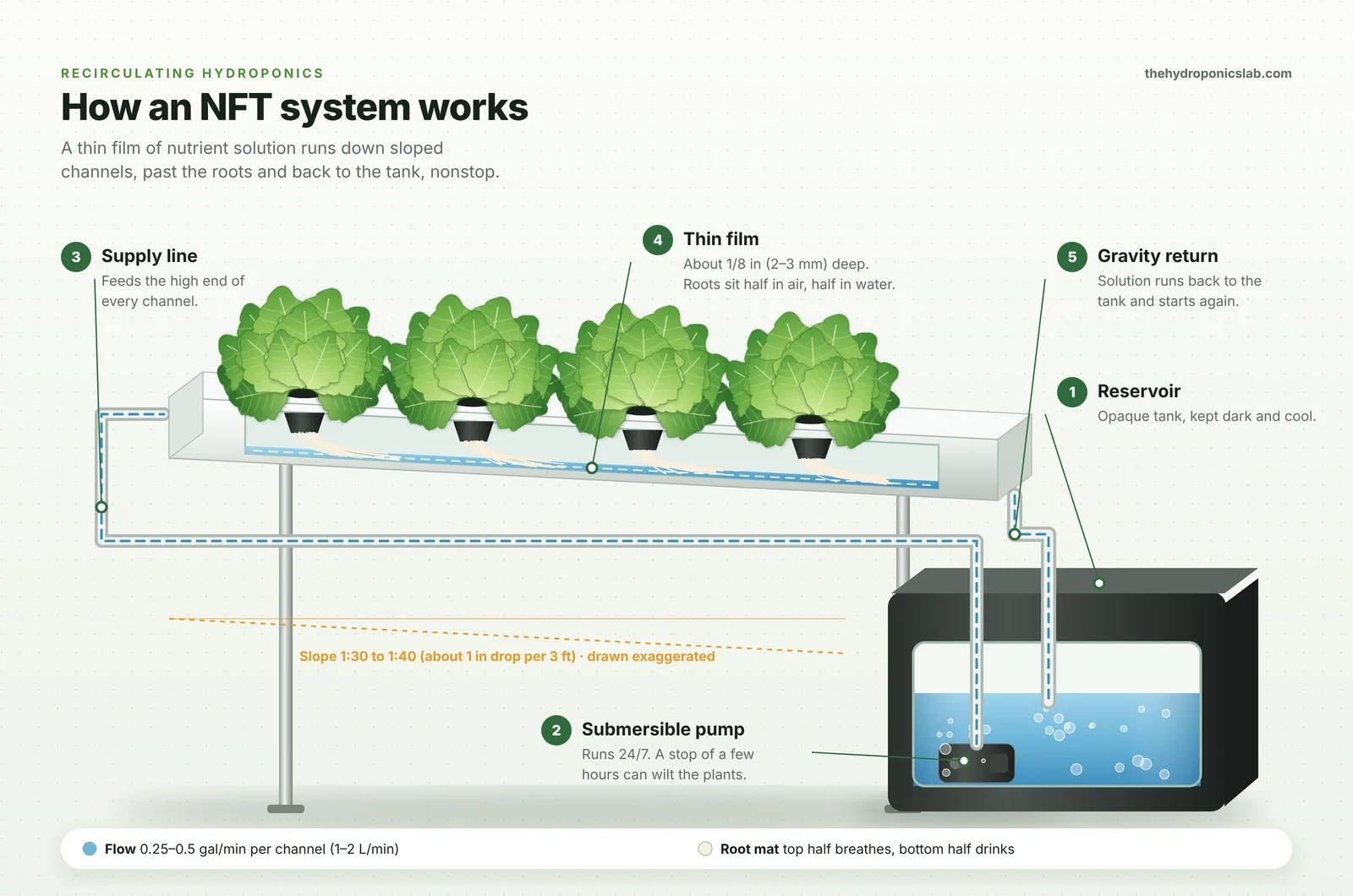
Quick answer: The nutrient film technique (NFT) is a recirculating hydroponic system in which a very thin stream of nutrient solution, only a few millimeters deep, flows continuously down a gently sloped channel. Plant roots sit in the channel; their lower part drinks from the film while the upper part stays in moist air and absorbs oxygen. The solution drains back to a reservoir and is pumped up again. NFT is best for lettuce, leafy greens, herbs and strawberries.
What is NFT
NFT was developed in the mid-1960s by Dr. Allen Cooper at the Glasshouse Crops Research Institute in England. His idea was to remove the bulky growing media of earlier systems and give roots exactly three things: water, nutrients and air, at the same time.
Instead of keeping roots submerged (as in deep water culture) or flooding and draining a tray (as in ebb and flow), NFT sends a shallow "film" of solution along the bottom of a channel. The roots form a flat mat on the channel floor. The film runs under and through the mat; the top of the mat is exposed to air inside the channel.
Today NFT is used commercially for lettuce, herbs, microgreens, strawberries and, in some greenhouses, tomatoes and cucumbers. For home growers it is the classic "next step" after Kratky and DWC, and the system behind most vertical towers and pipe gardens you see online.
How NFT works
Every NFT system has the same five parts:
- A reservoir holding the nutrient solution, usually below the channels.
- A submersible pump that pushes solution up to the high end of the channels.
- A supply line (manifold) that splits the flow evenly between channels.
- Channels (also called gullies or troughs) set at a slight slope, with holes on top for net pots or plant cups.
- A return line that carries the solution from the low end back to the reservoir.
The pump runs continuously. Solution enters at the top of each channel, flows down the slope in a thin film past the roots, and drains back. Because the volume in the channels is small at any moment, most of the solution sits in the reservoir, where you can measure and adjust it.
Why the film has to be thin
The whole system depends on the roots getting oxygen. Water holds very little dissolved oxygen, and a deep, slow-moving stream around a dense root mat soon runs short. A film only a few millimeters deep, constantly renewed, keeps the bottom of the roots wet and fed while the top of the mat breathes. If the film gets too deep, because the slope is too flat, the flow too strong or the roots dam the channel, the roots suffocate and rot.
Pros and cons of NFT
| Pros | Cons |
|---|---|
| Uses little water and nutrient; everything recirculates | Fully dependent on the pump: if it stops, roots dry out within hours |
| Little or no growing medium to buy or dispose of | Not suited to large, long-lived plants with heavy root systems |
| Roots get excellent oxygen, so leafy crops grow fast | Channels can clog with roots if plants grow too long |
| Easy to inspect roots and harvest | Temperature in channels can rise quickly in sun |
| Scales well: add channels, keep one reservoir | Small reservoirs swing quickly in pH and EC |
| Light, modular and easy to clean between crops | Needs a slope and a little building skill |
Slope, flow rate and channel length
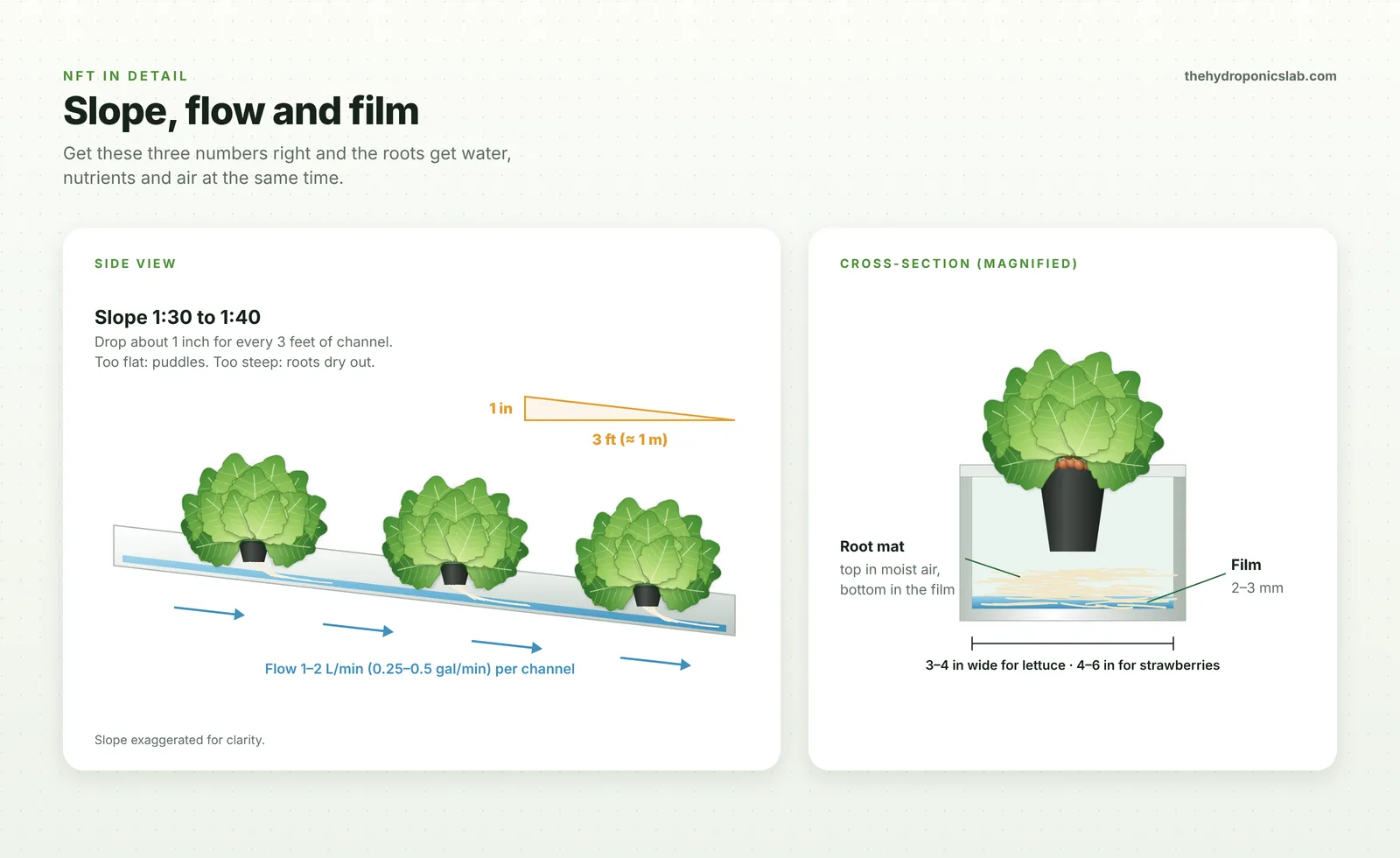
These three numbers decide whether an NFT system works. Most home failures come from getting one of them wrong.
| Setting | Recommended for home systems | Why it matters |
|---|---|---|
| Slope | 1:30 to 1:40 (about 1 inch drop for every 30 to 40 inches, or 2.5 to 3.3%) | Too flat and water pools; too steep and the film races past the roots |
| Flow rate | 0.25 to 0.5 gallon per minute per channel (1 to 2 liters per minute) | Too little and the far end runs dry; too much and roots sit in deep water |
| Channel length | Up to 10 to 15 feet (3 to 4.5 m) for home systems; commercial runs rarely exceed 40 feet (12 m) | In long runs, the solution warms up and loses oxygen and nutrients before the end |
| Film depth | About 1/8 inch (2 to 3 mm) | Deep enough to wet the roots, shallow enough to leave the top of the mat in air |
| Channel width | 3 to 4 inches (75 to 100 mm) for lettuce and herbs; 4 to 6 inches for strawberries and larger plants | Narrow channels clog as roots grow; wide channels spread the film too thin |
| Plant spacing | 6 to 8 inches (15 to 20 cm) for lettuce, 8 to 12 inches for strawberries and basil | Crowding reduces light and air and makes roots dam the channel |
These ranges are widely cited in horticultural guides; commercial growers tune them to the crop and climate. As a quick check, measure your flow with a measuring jug and a timer at the outlet of each channel.
What you need for a home NFT system
For a small system with 3 channels and 15 to 24 plants:
- Channels: purpose-made NFT gullies, or 3 to 4 inch PVC or vinyl downspout pipe (food-safe and opaque). See our PVC NFT system build.
- Net pots: 2 or 3 inch, with rockwool cubes, coco plugs or a few clay pebbles to hold seedlings.
- Reservoir: an opaque tote or tank. Aim for at least 1 to 2 gallons (4 to 8 liters) per plant for leafy greens; bigger is more stable.
- Submersible pump: rated for more than the total flow you need, after the height it has to push (check the pump's "head" chart). A 150 to 250 gallons-per-hour pump usually suits a small home system.
- Tubing and fittings: 1/2 inch supply line, a manifold with a valve for each channel, and wider return pipe (1 to 1.5 inch).
- A stand or frame that holds the channels at a steady slope.
- pH and EC meters, nutrients, pH Up and Down.
- A light source: a sunny greenhouse or an LED grow light above the channels.
- A timer or power backup (optional, but recommended; see the problems section).
Home setup, step by step
- Plan the space. Measure where the channels will go and how high the reservoir can sit below the low end. The return must drain by gravity.
- Build the frame. Set it so the channels fall about 1 inch for every 30 to 40 inches of length. Use a spirit level and wedges to fine-tune it.
- Prepare the channels. Cut plant holes along the top at the spacing for your crop. Close the high end with an end cap fitted with the supply inlet; fit the low end with an outlet that drains freely into the return.
- Install the pump and plumbing. Put the pump in the reservoir, connect it to the manifold, and run one supply line to the top of each channel. Fit a valve on each line so you can balance the flow.
- Test with water. Run the system with plain water for 24 hours. Check for leaks, measure the flow at each outlet and look for pooling. Adjust the slope and the valves until each channel has a thin, even film.
- Mix the nutrient solution. Fill the reservoir, add nutrients to your target EC, and set the pH to 5.8 to 6.2. See hydroponic nutrients.
- Add seedlings. Transplant seedlings that already have roots growing out of their cubes, so the roots reach the film at once. Very young seedlings with short roots can dry out; some growers place a strip of capillary mat on the channel floor for the first week.
- Monitor daily for the first two weeks. Check flow, EC, pH and water temperature, and look at the roots. Once it is stable, a check every one to two days is enough.
Best crops for NFT
NFT suits plants that are fast-growing, light, and harvested before their roots become huge.
| Crop | Suitability | Notes |
|---|---|---|
| Lettuce (all types) | Excellent | The classic NFT crop; 30 to 45 days from transplant. See hydroponic lettuce |
| Spinach, arugula, mizuna, bok choy | Excellent | Keep the solution cool for spinach |
| Basil, mint, parsley, cilantro, chives | Very good | Basil roots grow fast; trim or harvest before they clog the channel |
| Kale and Swiss chard | Good | Wider spacing and channels |
| Strawberries | Very good | Popular in commercial NFT; use wider channels and support for the fruit |
| Microgreens | Good | Grown on mats in wide, flat channels |
| Tomatoes, cucumbers, peppers | Possible, not ideal at home | Heavy roots can block channels; needs large channels and strong support |
| Root vegetables | Not suitable | The edible part needs a medium and space |
Common problems and how to fix them
Pump failure
This is the big risk in NFT. With only a thin film in the channels, roots can dry out and wilt within a couple of hours on a warm day if the pump stops. To protect your crop:
- Use a reliable pump and clean its intake filter every few weeks.
- Check the system every day.
- Consider a battery backup or a simple flow alarm.
- Keep a spare pump; it is the cheapest insurance in hydroponics.
Roots clogging the channel
As plants grow, the root mat can become thick enough to dam the flow, so water pools behind it and overflows or starves the plants downstream. Fixes: use wider channels for larger plants, space plants correctly, harvest on time, and do not leave a plant in a lettuce channel for months.
Dry or wilting plants at the end of the channel
The flow is too weak, the channel too long or the film is being absorbed before it reaches the end. Increase the flow a little, shorten the channel, or feed it from both ends.
Warm solution and root rot
Channels in sun can heat the solution well above the ideal 65 to 72°F (18 to 22°C). Warm water holds less oxygen and encourages pathogens such as Pythium. Use white or light-colored channels, shade the reservoir, insulate it, and in hot climates consider a chiller. See root rot in hydroponics.
Algae
Light entering the channels or reservoir grows algae, which competes for nutrients and clogs fittings. Use opaque channels, cover empty plant holes, and keep the reservoir lid closed.
pH and EC swings
A small reservoir feeding many plants changes quickly. Increase the reservoir size, top up with water daily, and replace the solution every 1 to 2 weeks.
Leaks
Always test with plain water first, and check end caps and joints after the first few days. A drip tray under the reservoir is a cheap safeguard indoors.
NFT vs DWC
NFT and deep water culture are the two most common systems for leafy greens. Both work very well; they suit different growers.
| NFT | Deep water culture (DWC) | |
|---|---|---|
| How roots get oxygen | Thin film plus air in the channel | Submerged roots, oxygen from an air pump |
| Water volume | Small in the channels, most in the reservoir | Large, around the roots |
| If the power fails | Roots can dry out in hours | Roots can lack oxygen in hours, but stay wet |
| Temperature stability | Lower (small volume, exposed channels) | Higher (large water volume) |
| Space use | Efficient, easy to go vertical or long | Bulkier, usually one level |
| Best for | Lettuce, herbs, strawberries at scale | Lettuce, herbs, and larger plants in buckets |
| Ease for beginners | Moderate: slope, flow and plumbing to get right | Easy: a bucket, an air pump and a lid |
If you are starting out, a DWC bucket or a Kratky tote is easier to get right. If you want to grow many heads of lettuce in a compact, efficient system, or you are planning a greenhouse, NFT is worth learning. Read our full comparison: DWC vs NFT.
Commercial NFT
Many of the NFT searches on Google come from students, teachers and people thinking about growing commercially. A few points matter at that scale:
- Channel design: commercial gullies are flat-bottomed, usually 4 to 6 inches wide, often with ribbed floors to spread the film evenly.
- Two-stage systems: many growers use narrow, tightly spaced nursery channels for young plants, then move them to wider, spaced finishing channels. This makes much better use of greenhouse space.
- Reservoir management: larger operations dose nutrients and acid automatically from EC and pH sensors, and often sterilize the returning solution with UV or filtration to control root diseases.
- Climate: root-zone temperature is critical; in warm regions, chilling the solution is often the difference between profit and crop loss.
Frequently asked questions
What does NFT stand for in hydroponics?
NFT stands for nutrient film technique: a recirculating system in which a thin film of nutrient solution flows past plant roots in a sloped channel.
What is the best slope for an NFT channel?
About 1:30 to 1:40, which is a drop of roughly 1 inch for every 30 to 40 inches of channel. Flatter slopes cause pooling; steeper ones let the solution rush past the roots.
What flow rate do I need for NFT?
For home channels, around 0.25 to 0.5 gallons per minute (1 to 2 liters per minute) per channel. Measure it at the outlet and adjust with a valve.
Should the pump run 24 hours a day?
Yes, in a standard NFT system the pump runs continuously. Some growers cycle it on and off in cool conditions, but continuous flow is safer for beginners.
Can you grow tomatoes in NFT?
Yes, commercial growers do, but tomatoes need wide channels, strong plant support and careful root management. At home, a drip or DWC bucket system is usually easier for tomatoes.
How long can plants survive if the NFT pump stops?
It depends on temperature and plant size, but large plants on a warm day can wilt within one or two hours. That is why a spare pump or a backup is worth having.
Do I need growing medium in NFT?
Only a small plug (rockwool, coco or a few clay pebbles) to support the seedling in its net pot. The roots grow out into the channel.
Is NFT better than DWC?
Neither is better overall. NFT uses less water and scales better; DWC is more forgiving of power cuts and temperature swings. For beginners, DWC is usually easier.
Next step
If NFT sounds right for you, start small: three channels, 15 to 20 lettuce plants and one reservoir. Run it for one crop cycle and keep a log of flow, EC, pH and temperature.
- Build it yourself: DIY PVC NFT system
- Compare all systems: types of hydroponic systems
- Pick your crop: hydroponic lettuce
Internal links to add: /systems/ pillar, /systems/dwc/, /diy/pvc-nft/, /crops/lettuce/.