In soil, a plant can find food in decaying matter, minerals and the life around its roots. In hydroponics, it has only what you put in the water. That makes the nutrient solution the single most important thing you control, and the most common reason a hydroponic garden struggles.
The good news is that feeding hydroponic plants is not complicated once you understand four things: which elements plants need, how nutrient products are packaged, how strong to make the solution, and how pH decides what the roots can actually absorb. This guide covers all four, with tables you can keep next to your reservoir.
Quick answer: Hydroponic nutrients are water-soluble mineral salts that supply the 14 mineral elements plants take from the root zone: nitrogen, phosphorus, potassium, calcium, magnesium and sulfur in large amounts, plus iron, manganese, zinc, copper, boron, molybdenum, chlorine and nickel in tiny amounts. Mix them into water to the strength your crop needs (measured as EC or ppm), set the pH to 5.5 to 6.5, and replace or refresh the solution every one to two weeks in recirculating systems.
The 17 essential elements
Plant scientists recognize 17 elements that plants need to complete their life cycle. If any one of them is missing, the plant cannot grow normally, however much of the others it has.
Three of them come from air and water: carbon (C), hydrogen (H) and oxygen (O). Plants take carbon from carbon dioxide in the air and hydrogen and oxygen from water. Together these make up most of a plant's dry weight.
The other 14 are mineral elements, which in nature come from the soil. In hydroponics, they come from your nutrient solution. This is where your work begins.
A few other elements are called beneficial rather than essential: silicon, sodium, cobalt and selenium. Plants can live without them, but some crops do better with them. Silicon, for example, strengthens cell walls in cucumbers, strawberries and many grasses, and some growers add it as a supplement.
Macronutrients vs micronutrients
The 14 mineral elements are split by how much the plant needs. Macronutrients are needed in large amounts (measured in tens to hundreds of ppm in the solution); micronutrients are needed in tiny amounts (often less than 1 ppm), but they are just as essential.
| Element | Type | Main role in the plant | Typical deficiency sign |
|---|---|---|---|
| Nitrogen (N) | Primary macro | Leaves, stems, proteins, chlorophyll | Older leaves turn pale yellow, slow growth |
| Phosphorus (P) | Primary macro | Roots, energy transfer, flowering | Dark or purplish leaves, stunted plants |
| Potassium (K) | Primary macro | Water balance, fruit quality, disease resistance | Scorched, yellow edges on older leaves |
| Calcium (Ca) | Secondary macro | Cell walls, new growth | Tipburn on lettuce, blossom end rot on tomatoes |
| Magnesium (Mg) | Secondary macro | Center of the chlorophyll molecule | Yellowing between veins on older leaves |
| Sulfur (S) | Secondary macro | Proteins, flavor (onions, brassicas) | Uniform yellowing of young leaves |
| Iron (Fe) | Micro | Chlorophyll production | Yellowing between veins on new leaves |
| Manganese (Mn) | Micro | Photosynthesis, enzymes | Mottled yellowing on young leaves |
| Zinc (Zn) | Micro | Growth hormones, leaf size | Small, distorted new leaves |
| Copper (Cu) | Micro | Enzymes, lignin | Wilting, dark or twisted new leaves |
| Boron (B) | Micro | Cell division, pollination | Dead growing tips, brittle leaves |
| Molybdenum (Mo) | Micro | Nitrogen use | Pale, cupped leaves, like nitrogen shortage |
| Chlorine (Cl) | Micro | Water balance, photosynthesis | Rare in practice (tap water supplies it) |
| Nickel (Ni) | Micro | Nitrogen metabolism (urease) | Rare in practice |
Mobile and immobile nutrients: a shortcut to diagnosis
Some nutrients can move inside the plant from old leaves to new ones; others cannot. This is the most useful fact in diagnosing a hungry plant.
- Mobile nutrients (nitrogen, phosphorus, potassium, magnesium): when they run short, the plant takes them from its older leaves to feed new growth. Symptoms show on the lower, older leaves first.
- Immobile nutrients (calcium, iron, sulfur, manganese, zinc, copper, boron): once placed, they stay put. Symptoms show on the new growth at the top first.
So yellowing at the bottom usually points to nitrogen or magnesium; yellowing at the top usually points to iron, and often to a pH problem rather than a shortage. Our diagnosis guide walks through each symptom with photos.
What NPK numbers mean
Every nutrient label carries three numbers, such as 4-0-1 or 2-1-6. They are the percentages of nitrogen (N), phosphate (P2O5) and potash (K2O) in the product. They tell you the balance of the three primary nutrients, but nothing about calcium, magnesium or the micronutrients, which matter just as much in hydroponics. Two products with the same NPK can perform very differently.
As a broad rule, leafy greens and the vegetative phase of any plant like more nitrogen; flowering and fruiting plants want relatively more phosphorus and especially potassium.
Types of hydroponic nutrients
All hydroponic nutrients contain the same elements. What changes is how they are packaged, which affects price, convenience and how precisely you can tune the mix.
Liquid or powder
- Liquid concentrates are the easiest to measure with a syringe or measuring cup and dissolve instantly. They cost more per gallon of solution because you are paying to ship water.
- Powder (dry) nutrients are much cheaper per gallon and keep for years if stored dry. They take a little longer to dissolve and need a scale or measuring spoons.
One-part, two-part and three-part
The reason nutrients come in several bottles is chemistry, not marketing. Calcium reacts with sulfates and phosphates when concentrated, forming insoluble solids (essentially gypsum and calcium phosphate) that fall to the bottom of the bottle. Separating calcium (usually as calcium nitrate) from the sulfates and phosphates keeps everything dissolved until it is diluted in your reservoir.
| Type | How it works | Best for | Watch out for |
|---|---|---|---|
| One-part | Single product, carefully formulated to stay stable | Kratky jars, beginners, herbs | Less control over the balance |
| Two-part (A + B) | Calcium in one part, sulfates and phosphates in the other | Most home systems, leafy greens, general use | Never mix A and B concentrates directly |
| Three-part (grow, micro, bloom) | Lets you change the ratio between growth and flowering | Growers with several crops or long-lived fruiting plants | More measuring, easy to overthink |
| Lettuce or leafy greens powder + calcium nitrate + Epsom salt | Base powder plus separate calcium and magnesium | Large Kratky or DWC lettuce setups on a budget | Measure each part separately, by weight |
Whichever you choose, add each part to the full volume of water separately and stir between them. Pouring part A into part B, or both into a small cup together, causes the precipitation described above.
Organic hydroponic nutrients
Organic nutrients are possible in hydroponics, but they behave differently. Plants still absorb minerals, not organic matter; organic products have to be broken down by microbes into mineral forms first. In a sterile, recirculating system this happens slowly and unevenly, and organic liquids can feed bacteria, clog pumps and emitters, and make the solution smell.
If you want to go organic, the systems that cope best are those with a living component, such as aquaponics or media beds with active microbes. For Kratky, DWC and NFT, mineral nutrients are much more reliable. Our guide to organic hydroponics covers the options in detail.
How much to use: EC and ppm by crop
The label gives you a starting dose. A meter tells you what is actually in the water. The two units you will see are EC and ppm.
- EC (electrical conductivity) measures how well the solution conducts electricity, which rises as you add mineral salts. It is shown in mS/cm (millisiemens per centimeter), sometimes as "CF" (EC × 10), common in Australia and New Zealand.
- ppm (parts per million), also called TDS, is an estimate calculated from EC. Meters use different conversion factors, so the same solution reads differently on different meters.
| EC (mS/cm) | CF | ppm, 500 scale (US, Hanna, many TDS pens) | ppm, 700 scale (UK, Australia, Truncheon) |
|---|---|---|---|
| 0.5 | 5 | 250 | 350 |
| 1.0 | 10 | 500 | 700 |
| 1.5 | 15 | 750 | 1,050 |
| 2.0 | 20 | 1,000 | 1,400 |
| 2.5 | 25 | 1,250 | 1,750 |
| 3.0 | 30 | 1,500 | 2,100 |
Because of this confusion, EC is the better unit to use: it means the same thing everywhere. Our EC to PPM converter does the conversion for you.
Target strength by crop
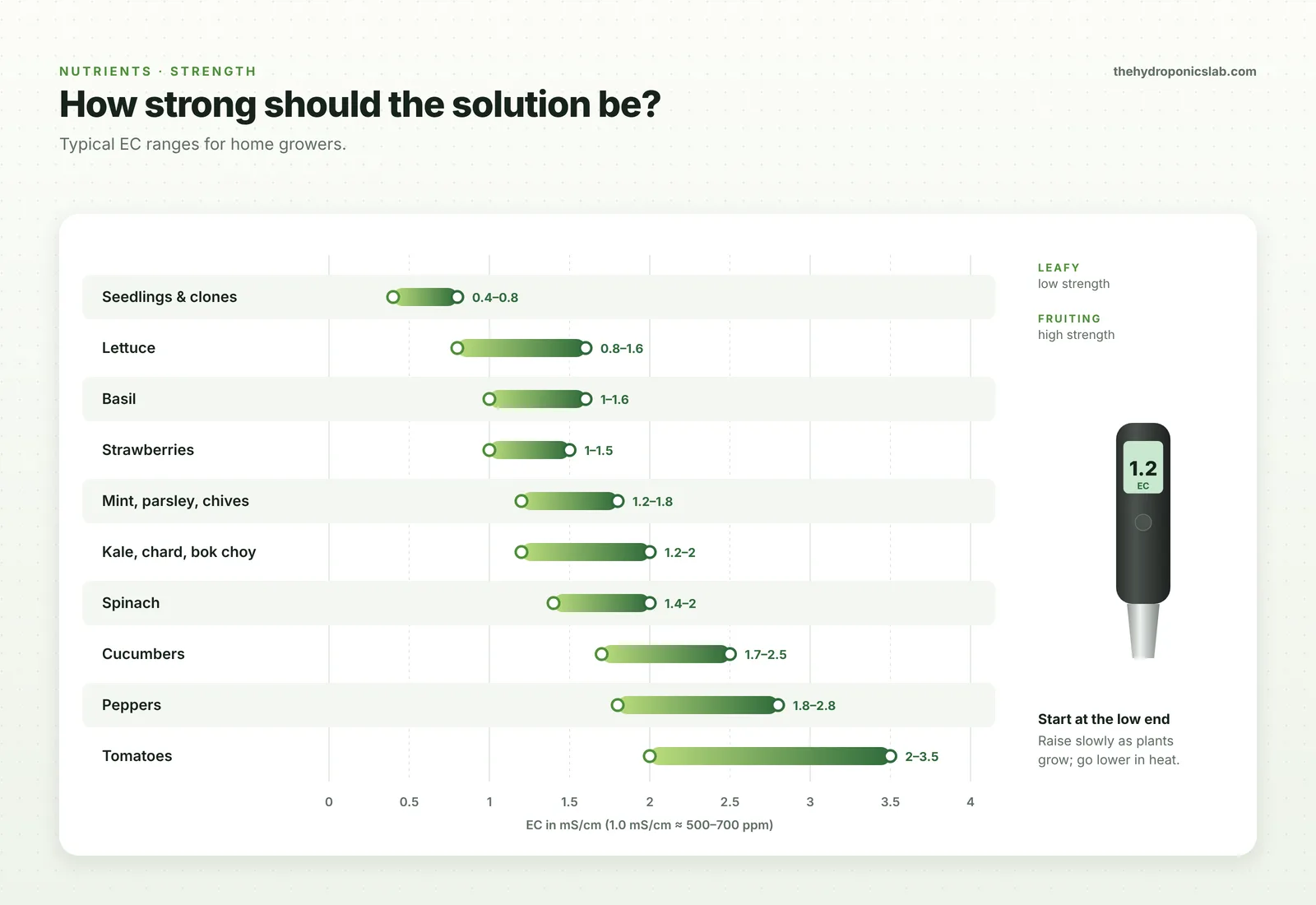
These are typical working ranges for home growers. Start at the low end, watch the plants, and raise the strength gradually.
| Crop | EC (mS/cm) | ppm (500 scale) | pH |
|---|---|---|---|
| Seedlings and clones | 0.4 to 0.8 | 200 to 400 | 5.8 to 6.2 |
| Lettuce | 0.8 to 1.6 | 400 to 800 | 5.8 to 6.2 |
| Spinach | 1.4 to 2.0 | 700 to 1,000 | 6.0 to 6.5 |
| Basil | 1.0 to 1.6 | 500 to 800 | 5.8 to 6.2 |
| Mint, parsley, chives | 1.2 to 1.8 | 600 to 900 | 5.8 to 6.5 |
| Kale, chard, bok choy | 1.2 to 2.0 | 600 to 1,000 | 6.0 to 6.5 |
| Strawberries | 1.0 to 1.5 | 500 to 750 | 5.8 to 6.2 |
| Cucumbers | 1.7 to 2.5 | 850 to 1,250 | 5.8 to 6.0 |
| Peppers | 1.8 to 2.8 | 900 to 1,400 | 5.8 to 6.3 |
| Tomatoes | 2.0 to 3.5 | 1,000 to 1,750 | 5.8 to 6.3 |
Ranges come from horticultural extension guides and commercial practice; published sources differ by a few tenths, so treat them as a starting point, not a rule. Warmer, brighter conditions usually call for the lower end, because plants drink more water and concentrate the solution.
Start with your water
Before you add anything, measure the EC of your tap water. Soft water may read 0.0 to 0.2; hard water can read 0.5 or more, mostly calcium and magnesium. Your target EC is the total, so with hard water you add less nutrient. If your water is above about 0.6 to 0.8, consider mixing it with filtered (reverse osmosis) water or rainwater, and look for a nutrient labeled for hard water.
pH and nutrient availability
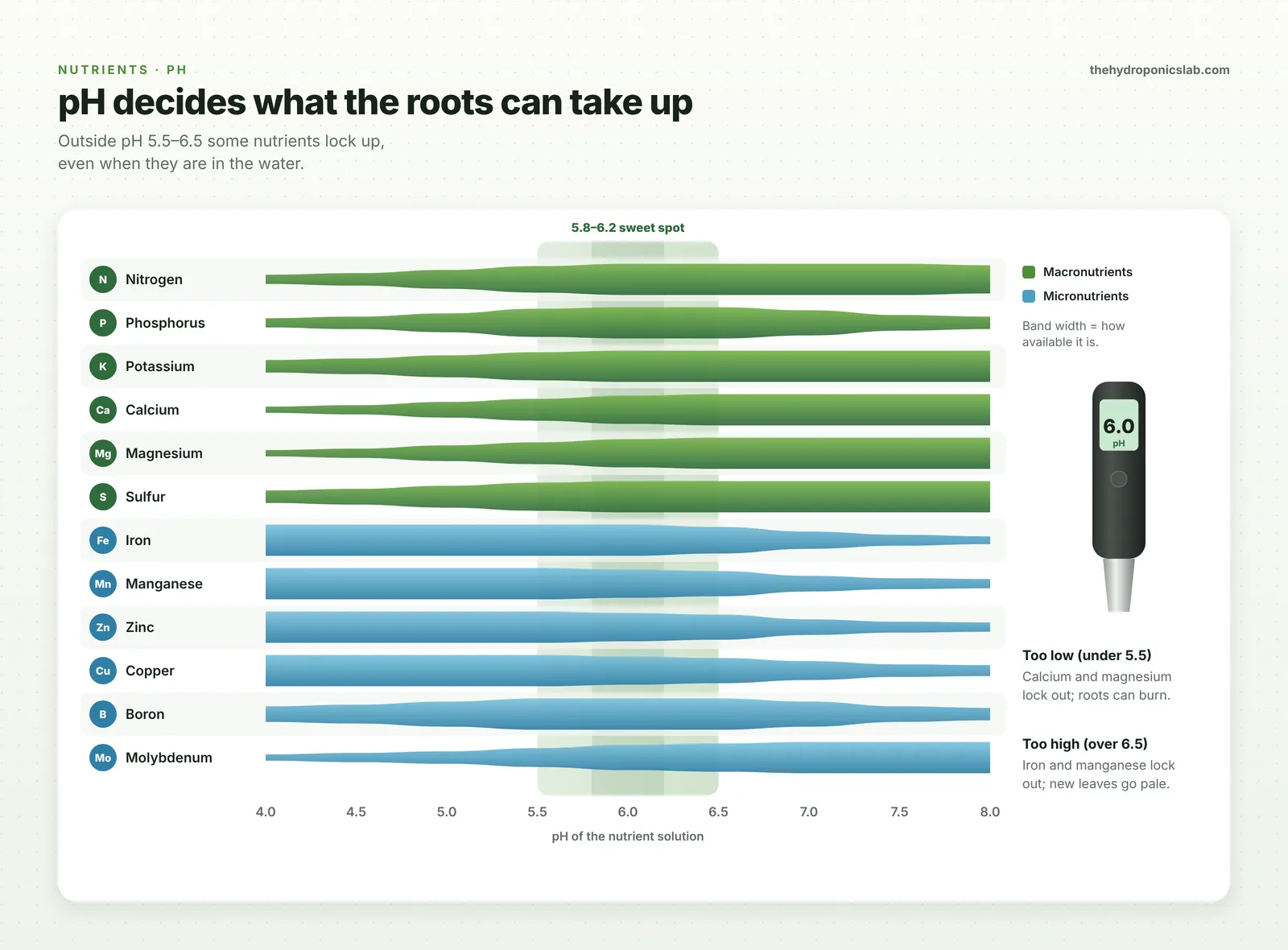
pH measures how acidic or alkaline the solution is, on a scale from 0 to 14, with 7 as neutral. It does not measure how much food is in the water. What it controls is whether the nutrients that are there can be absorbed.
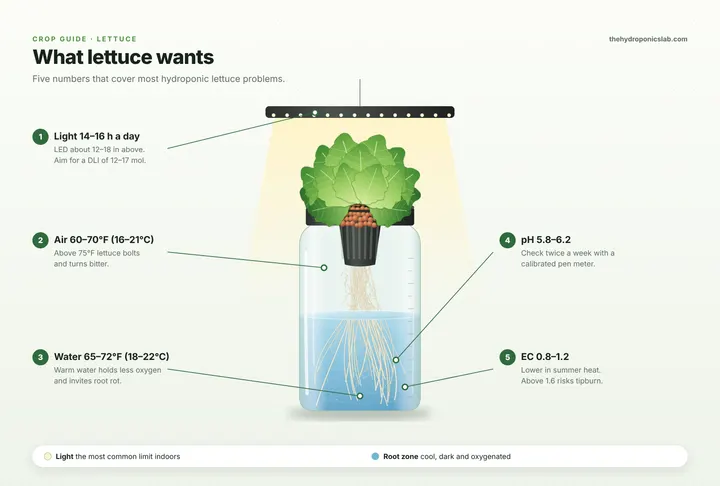
In hydroponics, most nutrients are available between pH 5.5 and 6.5, and most crops do best between 5.8 and 6.2. Outside that window, some elements lock up even though they are dissolved in the water:
- Above 6.5, iron, manganese, zinc and phosphorus become hard to absorb. New leaves turn yellow between the veins, which looks like iron deficiency even with plenty of iron in the tank.
- Below 5.5, calcium and magnesium uptake falls, and at very low pH roots can be damaged.
How to adjust pH
- Mix the nutrients into the water first. They change the pH, so always adjust afterward.
- Stir and measure with a calibrated pen or a liquid test kit.
- Add pH Down (usually phosphoric or nitric acid) or pH Up (potassium hydroxide or carbonate) a few drops at a time.
- Stir, wait one to two minutes, and test again.
- Recheck the next day; fresh solutions often drift a little at first.
In recirculating systems, the pH usually rises slowly as plants take up nitrate. A drift of 0.2 to 0.3 over a few days is normal. Large daily swings suggest a reservoir that is too small for the number of plants, or a problem with the roots. Full details are in our guide to the ideal pH for hydroponics.
Mixing a nutrient solution, step by step
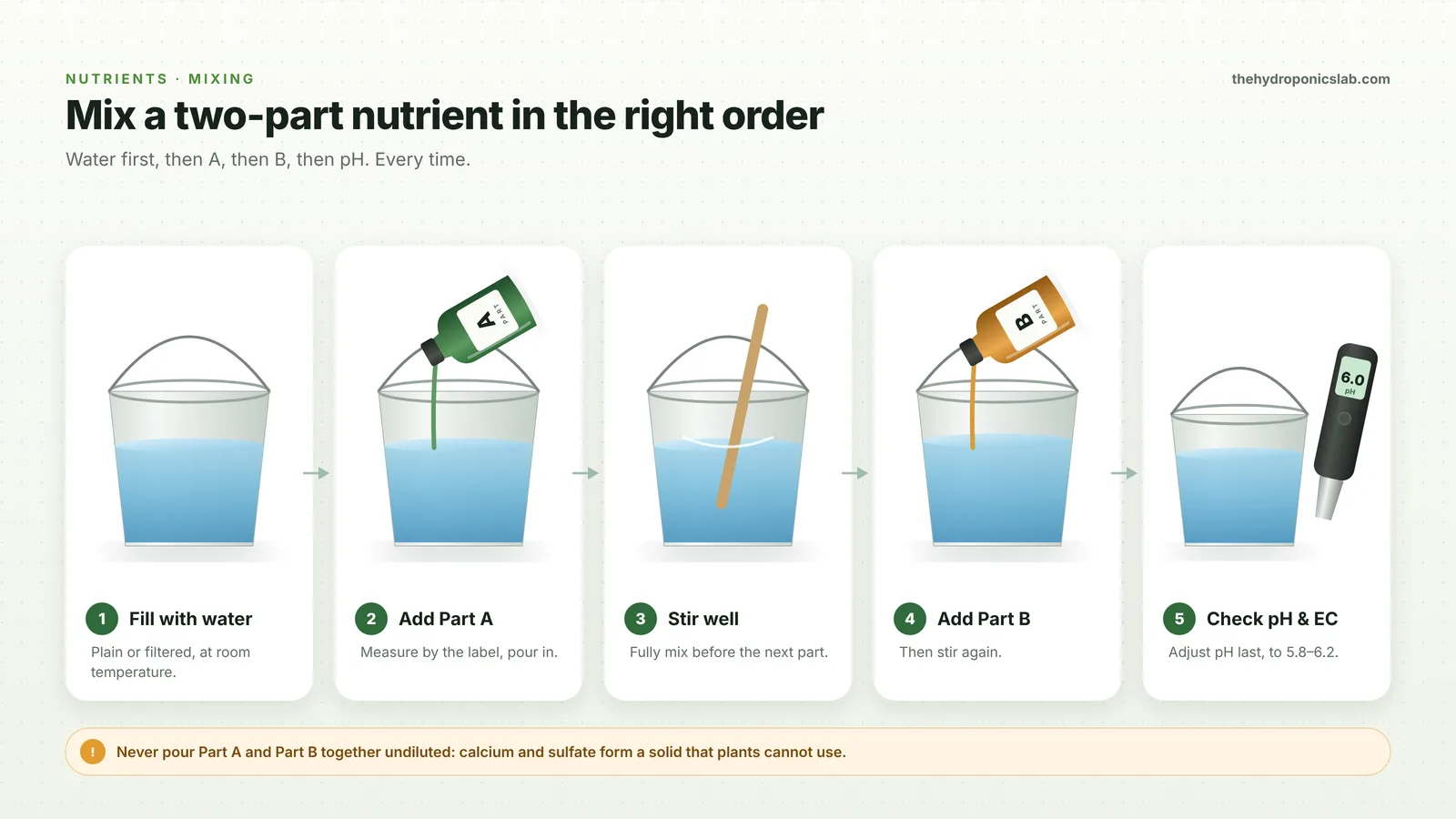
- Fill the reservoir with water to its working level. Note the volume.
- Check the starting EC of the water.
- Add part A (or your one-part product) at the label dose for your crop and growth stage. Stir thoroughly.
- Add part B, then any other parts, stirring between each addition.
- Add supplements last if you use them (silicon is usually added first, before the base nutrients; check the label).
- Measure EC and add more nutrient or more water to reach your target.
- Adjust pH to the target range.
- Record the date, EC and pH on a reservoir log. These numbers make every future problem easier to solve.
Water temperature matters too. Aim for 65 to 72°F (18 to 22°C). Warm solutions hold less dissolved oxygen and encourage root rot; very cold solutions slow growth.
Changing the solution
Plants do not take up every element at the rate it was supplied. Over time, some build up and others run low, and EC and pH readings stop telling the whole story. That is why recirculating systems need a regular refresh.
- Top up between changes with plain water (or a weak solution) to replace what the plants drank. If the EC rises as the level falls, the plants are drinking more water than nutrients: top up with water. If the EC falls, they are eating faster than drinking: top up with a mild solution.
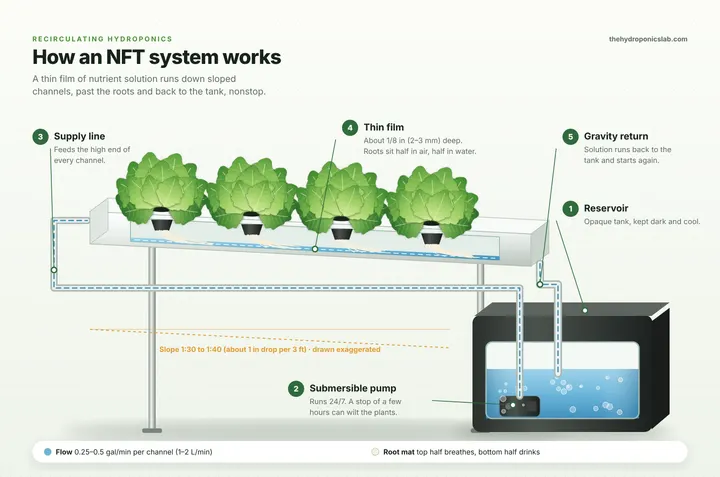
- Change the solution completely every 1 to 2 weeks in DWC, NFT, ebb and flow and drip systems. Small reservoirs, warm weather and many large plants mean more frequent changes.
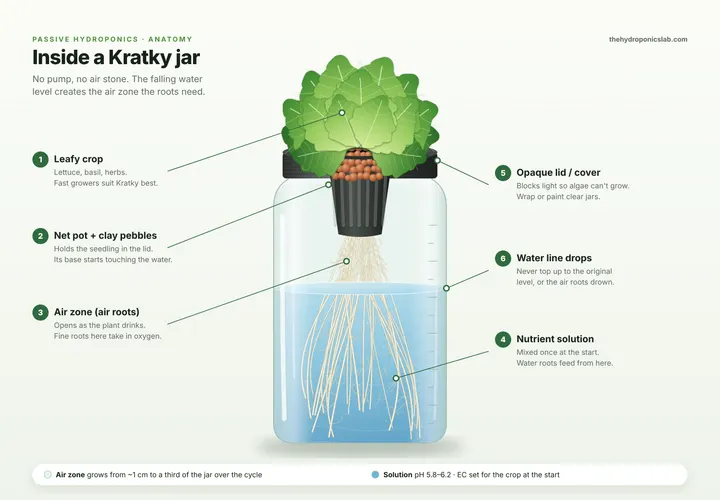
- Kratky is the exception. The solution is mixed once and not changed during the crop. See Kratky nutrients.
Old solution is not toxic waste. Diluted, it makes good feed for houseplants, outdoor beds or the lawn.
Deficiency and excess signs
Most "deficiencies" in home hydroponics are not shortages at all. They are caused by a pH outside the right range, a solution that is too weak or too strong, or roots that are damaged and cannot absorb anything. Before you add a supplement, check these three things in order:
- pH: is it between 5.5 and 6.5?
- EC: is it in the range for your crop?
- Roots: are they white and firm, or brown and slimy?
Signs of a solution that is too strong include dark green leaves with burnt, brown tips, curled leaf edges and wilting even when the reservoir is full. Dilute with water and the plant usually recovers within days.
For symptom-by-symptom photos, see yellow leaves in hydroponics and our full problems guide.
How to choose the best nutrients for your system
There is no single best brand. There is a best type for your setup:
- One jar or a few Kratky containers: a one-part liquid or a two-part made for leafy greens.
- A home DWC or NFT system growing lettuce and herbs: a two-part liquid or a leafy-greens powder kit. Simple, stable and affordable.
- Tomatoes, peppers, cucumbers or strawberries: a three-part or a two-part with a separate bloom formula, so you can raise potassium when the plants start fruiting.
- Hard tap water: a nutrient formulated for hard water, which contains less calcium and magnesium.
- Large reservoirs on a budget: powders, measured by weight.
Whatever you buy, look for a product that lists all the macro and micronutrients on the label, uses chelated iron (it stays available at a wider pH range), and is designed for hydroponics, not soil.
Frequently asked questions
Can I use regular fertilizer for hydroponics?
Usually not. Most soil fertilizers lack calcium, magnesium or micronutrients, because they assume the soil supplies them, and some contain forms of nitrogen (urea, ammonium) that are poorly suited to hydroponics in large amounts. Use a product made for hydroponics.
How often should I add nutrients?
In recirculating systems, mix a full solution at each change (every 1 to 2 weeks) and adjust EC with top-ups in between. In Kratky, add nutrients once at the start.
What is the best EC for lettuce?
About 0.8 to 1.6 mS/cm, or 400 to 800 ppm on the 500 scale. Read our guide to hydroponic nutrients for lettuce for a full feeding plan.
Why does my pH keep rising?
A slow rise is normal: as plants take up nitrate, they release compounds that raise the pH. A fast rise can mean a small reservoir, very active growth, or rising alkalinity from hard water. Check root health, and refresh the solution more often if needed.
Do I need Cal-Mag?
Only in specific cases: when you use reverse osmosis or very soft water with a nutrient that expects some calcium in the water, or when you grow calcium-hungry crops like tomatoes and lettuce in hot weather. Most complete two-part nutrients already contain enough calcium and magnesium for tap water.
How long does mixed nutrient solution last?
In a reservoir with plants, plan to replace it every 1 to 2 weeks. Mixed solution stored in a dark, cool container can last a few weeks, but it is best mixed fresh.
Can I make my own hydroponic nutrients?
Yes, from individual salts such as calcium nitrate, potassium nitrate, monopotassium phosphate, magnesium sulfate and a micronutrient mix. It is the cheapest option at scale, but it needs a precise scale and some calculation. Our nutrient calculator and mixing guide help you start.
Next step
Feeding is the part of hydroponics where a meter pays for itself fastest. If you have not yet, buy a pH pen and an EC meter, start a simple reservoir log, and you will solve most problems before you can see them on the leaves.
- Set the right pH: the ideal pH for hydroponics
- Convert your readings: EC vs PPM chart and converter
- Mix like a pro: how to mix hydroponic nutrients
Internal links to add: /nutrients/ph/, /nutrients/ec-ppm/, /nutrients/mixing/, /problems/yellow-leaves/, nutrient calculator tool.
Before publishing: add a sourced reference for the EC table (for example a university extension guide) and the pH availability diagram.